Lotions, Potions & Skincare Dramas: Let’s Quash the 10-Step Chaos
Updated: Apr 28
Skincare Dramas... So Over It.
The half-used serums, the mystery creams, the “miracle” elixirs that never quite lived up to the hype — my bathroom drawer is a graveyard of lotions, potions, and hope in a bottle.

Been there, done that, wish I had that cash back.
It’s time to simplify, get real about what actually works for our 60-something skin, and reclaim a little peace (and counter space).
Menopause Jacked My Glow
Menopause comes with all kinds of fun — hot flashes, mood swings, and yes, skin that suddenly goes from dewy to the freakin’ Sahara Desert overnight. Honestly, it makes me want to take to the bed!
What’s happening!? Why is nothing working!?
Here’s the thing — it’s not just our imagination. Our skin really does change dramatically after menopause. Collagen and elasticity start to decline as early as our late 20s — about 1% per year — but once we hit menopause, it’s like the bottom falls out. That slow leak becomes a landslide: we can lose up to 30% of our collagen in the first five years after menopause, and another 2% each year after that.
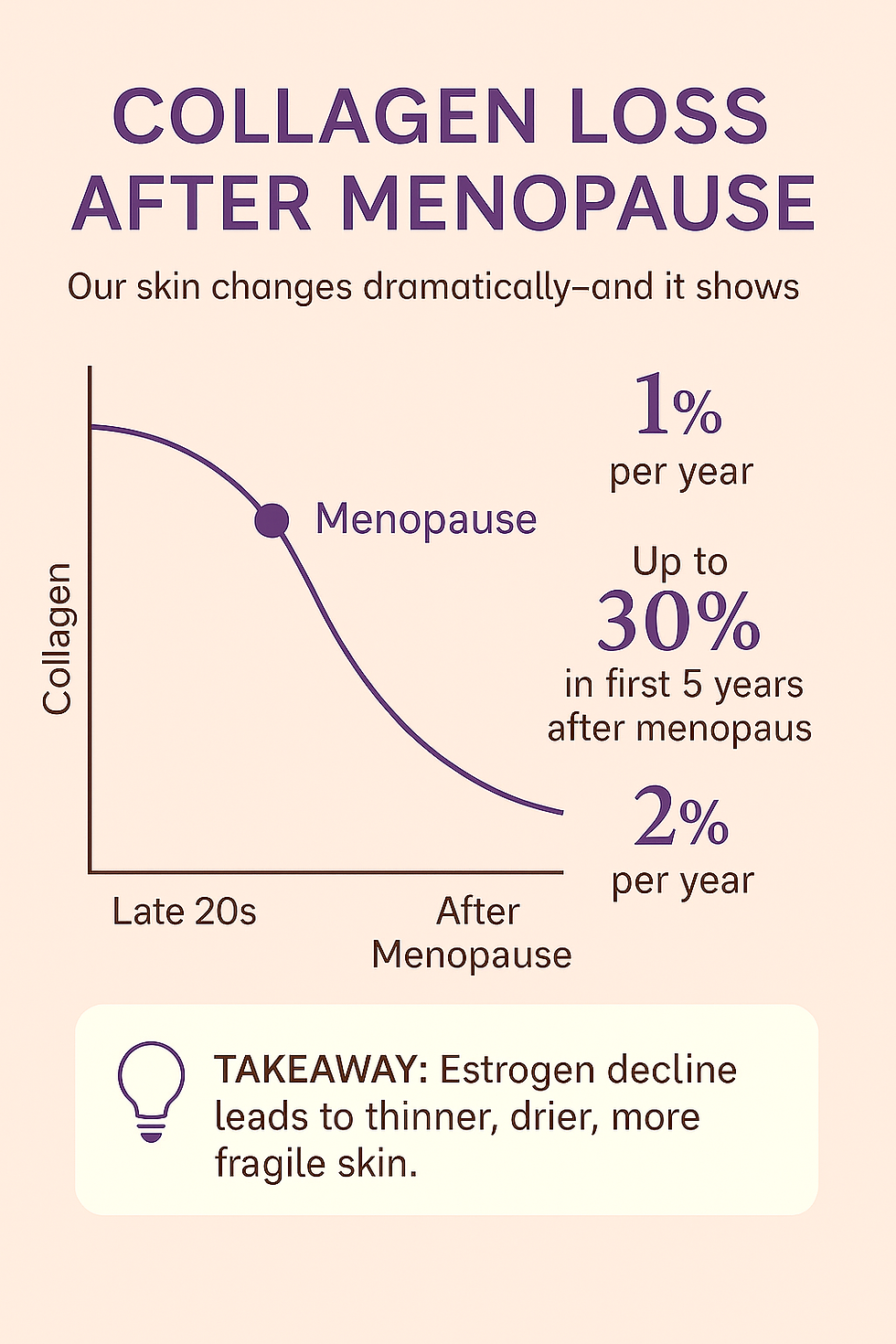
The result? Thinner, drier, more fragile skin seemingly overnight. Wrinkles deepen, dullness creeps in, under-eyes get crepey, and there it is — the dreaded sag where things used to stay put. My husband has heard more than a few of my exasperated sighs and whimpering proclamations — “My face is falling!” — as I catch my reflection in the morning mirror.
By our 60s, our skin is a whole new ballgame — menopause really has jacked our glow. No wonder our old routines don’t cut it anymore.
Choosing Products Wisely (Clean & Effective)
There’s a growing movement toward “clean” products — ones that avoid toxic ingredients, hormone disruptors, and things we’d frankly rather not slather on our skin. Some say clean beauty is just a marketing trend. I don’t think so. I think we’re finally waking up to what a largely unregulated beauty industry has been putting in our products.
The U.S. is way behind, by the way. The European Union bans or restricts over a thousand cosmetic ingredients; here in the States, it’s only a few dozen. So sometimes it feels like we’re left to fend for ourselves — trying to decode labels and figure out what’s actually safe.
That’s how I ended up downloading an app called Yuka (I also use EWG, as I mentioned in a previous post). You scan a product, and it does the label-reading for you — flagging questionable ingredients and potential risks. Suddenly, I was scanning everything in sight: my bathroom shelf, my shower caddy, and eventually half the aisles at Ulta. Wow. Honestly? It was shocking. Things I assumed were fine — “clean” brands, prestige brands — came back with “moderate concern” or even “bad” scores.


I confess, I went a little overboard at first and refused to use anything that didn’t score “excellent” on the app. The good news? My sensitive skin was happy. The bad news? I wasn’t sure some of the products I’d found were actually effective.
Still, clean matters to me — for many reasons: reducing toxic load, calming inflammation, supporting brain health, and more.
So where’s the middle ground? I’ve realized that apps like Yuka are tools — great for spotting trends and red flags quickly — and then I decide whether a risky ingredient is a deal-breaker. I no longer stress over every single ingredient, but I do pay attention to the ones that cause the most damage to post-menopausal skin.
🚫 Watch List: Ingredients to Think Twice About
Fragrance — a top trigger for irritation and sensitivity at our age.
Drying alcohols — look for SD alcohol or denatured alcohol; they strip moisture from already-dry skin.
Parabens, sulfates, phthalates — older preservatives and surfactants. Thankfully, easier to avoid than they used to be.
“Forever chemicals” (PFAs) — best avoided entirely. These often appear in long-wear or waterproof makeup. I scan labels for anything with fluoro in the name. On ingredient lists, they show up as:
“Perfluoro…” (e.g., perfluorodecalin, perfluorohexane)
“Polyfluoro…”
PTFE (yep, like Teflon)
💡 Heads Up: Luxury and “clinical-grade” lines aren’t immune — several have been flagged for moderate-risk ingredients. Until the beauty industry is better regulated, pairing Yuka-style scanning with a personal watch list is the smartest way to shop intentionally and decide where to compromise (or not).

✅ Ingredients That Actually Do Something Good
Now that we know what to avoid, let’s talk about the ingredients that move the needle. These are the workhorses — the ones that help restore some of what time and hormones have taken.
✴️ Anti-Aging & Firming
Retinoids (retinol, tretinoin): Boost collagen and smooth wrinkles. Gold standard for texture and firmness over time. For sensitive skin, bakuchiol offers retinol-like benefits with fewer side effects.
Vitamin C: Brightens dull skin and supports collagen; a must for defending against oxidative stress.
Peptides: Signal skin to produce collagen and elastin — the support crew for firmness.
AHAs (glycolic, lactic): Gentle exfoliation to smooth texture and even tone.
💧 Hydration & Barrier Support
Hyaluronic Acid: Pulls moisture into the skin for plumpness and bounce.
Ceramides: Rebuild and strengthen the skin barrier, keeping hydration locked in.
Squalane: Lightweight oil that softens and protects without greasiness.
Niacinamide: Calms redness, refines pores, and supports barrier function.
Aloe Vera: Soothes and hydrates — especially helpful when skin feels reactive.
☀️ Sun Protection
Mineral sunscreen (zinc oxide, titanium dioxide): Daily, non-negotiable protection against further collagen breakdown and hyperpigmentation.
💡 Tip: You don’t need all of these in every product. Aim for balance — an antioxidant, a hydrator, a barrier-builder, and SPF. That’s your foundation. From there, add extras only if your skin truly needs them.
Permission to Purge: The Core Routine That Works
Most of those lotions and potions in our drawers are doing little more than taking up space and stressing us out. Consider this your official permission to purge… buh-bye! You’ll feel lighter, more organized, and maybe even a little freer (as you do whenever you declutter any part of life).
At this stage of life, we are so over complicated routines. Focus on proven ingredients, tune out the marketing madness, and simplify. My skin is thanking me — and I’m betting yours will too.
Start by thinking of your skin as a canvas — time to clear the deck. I love a good facial with a dermaplaning add-on to remove peach fuzz and dead cells. It helps everything you apply afterward absorb better (and for makeup lovers, foundation glides on smoother).
Then, build your simplified routine:
🌞 AM — Only 4 Steps
1️⃣ Cleanse — Gentle and hydrating; save money here for the steps that matter.
2️⃣ Treat (Vitamin C Serum) — Brighten and protect. Notice what’s missing? Ten other serums.
3️⃣ Moisturize — Your workhorse. Not glamorous, but neither is flaky skin.
4️⃣ Protect — Daily SPF, non-negotiable. Think of it as rent you pay for your face. Skip it, and eviction (aka sun damage) comes due fast.
🌑 PM — Only 3 Steps
1️⃣ Cleanse — Same gentle cleanser.
2️⃣ Treat (Retinoid) — Your night-shift worker. Retinoids + AM Vitamin C = a powerful collagen-support duo.
3️⃣ Moisturize — The same one from morning — it knows how to multitask.
💡 Tip on PM Actives: If your skin is sensitive, apply moisturizer before tretinoin (“the sandwich method”).
💡 Exfoliation: Our skin no longer wants boot camp. Retinoids handle most exfoliation needs. If you’re not using one, try a mild AHA once or twice a week, or an enzyme mask as an occasional treat.
Is anyone counting? We’ve dialed in our base routine with only five products — cleanser, serum, moisturizer, SPF, and an evening retinoid. Yay!

💭 Settle into your new streamlined routine and enjoy it. If there ever comes a time when your skin needs a little extra love, you can always consider a booster — not an overhaul, not another daily step — just an as-needed upgrade. Let’s talk about those next...
Skincare’s Special-Occasion Squad (a.k.a. The Heavy Hitters)
Sometimes life gives us a reason to want a little extra. A big birthday, a wedding, an anniversary trip — those milestone moments when you wonder if a quick professional boost might help your skin look its best. These aren’t everyday essentials; they’re occasional splurges that can make a visible difference when timed right.
💬 Think of these as the supporting cast to your five-product foundation — powerful, but not meant to steal the show.
⭐ Microneedling
This one’s on deck for me. Tiny needles nudge your skin into making more collagen — the idea sounds medieval, but most describe it as “scratchy” rather than painful. I’m hoping it’ll help shrink the ginormous pores on my nose and smooth fine lines. Results build gradually: smoother texture, a bit more firmness, and that “fresh skin” glow after a few rounds.
⭐ BBL / IPL (Broadband or Intense Pulsed Light)
I tried this before my son’s wedding because I was tired of the brown spots and broken capillaries staring back at me. It really did zap them well — tiny bee-sting sensations with each flash, followed by about a week of little red specks that faded quickly. When they cleared, my skin looked more even. Fast-forward to today? New spots, new love-hate relationship. I’ll need another big event to justify round two.
⭐ Lasers (like Fraxel or Halo)
Oh boy. I did the Halo for that same wedding and let me tell you — the most painful cosmetic thing I’ve ever done on my sensitive skin. I honestly thought she burned my face off. My skin was on fire for days, and I hid out for a good week (maybe more; I’ve probably blocked it out). The good news? A month or two later, my skin looked the best it had in a decade. The bad news? Never again. Others swear by it, but for me — I’ll stick to my skincare products and maybe that microneedling appointment.
💡 Takeaway: Think of your daily routine as your foundation — steady, consistent, long-term. These “special-occasion squad” options pack more punch, but they’re not meant for everyday life. If you’re curious, start with one treatment, give it time to show results, and keep your expectations (and your skin barrier) realistic.

Wrapping It Up
At the end of the day, skincare in our 60s doesn’t need to be a 12-step production. Build a solid base — cleanser, serum, moisturizer, SPF, and your nighttime retinoid — and stick with it. Everything else? Optional sprinkles.
💬 It’s not about chasing 30 again. It’s about showing up every day feeling confident, comfortable, and authentically you — skin included.
So here’s to simplifying the routine, embracing what works, and letting go of the rest.
Stay curious, friends.
🧠 Sources & Further Reading
Loss of Collagen After Menopause: Naylor EC, Watson REB, Sherratt MJ. Molecular aspects of skin ageing. Maturitas. 2011;69(3):249-256.Zouboulis CC et al. Human skin: from basic structure and function to therapies. Exp Dermatol. 2014;23(7):485-495.
Collagen Decline Percentages (1% yearly / 30% in first 5 years post-menopause):Brincat M. Hormone replacement therapy and the skin. Maturitas. 2000;35(2):107-117.
EU vs. U.S. Cosmetic Regulation: European Commission: Cosmetics Regulation (EC) No 1223/2009.U.S. FDA: Overview of Cosmetics Regulation.
PFAS (“Forever Chemicals”) in Cosmetics: U.S. Geological Survey, 2021: PFAS detected in cosmetics marketed in the U.S.Environmental Science & Technology Letters, June 2021.
Phenoxyethanol, Parabens, and Common Preservatives: Scientific Committee on Consumer Safety (SCCS), European Commission, Opinion on Phenoxyethanol, 2016.
Comments