Part 2: The Everyday Exposure Edit
Updated: May 12
Where it shows up and some practical swaps

In Part 1, we talked about why this topic is suddenly everywhere, what these everyday exposures may be doing in the body over time, and how small changes can help reduce some of that load.
Now it is time to look at where this stuff actually shows up in normal life — in the everyday routines most of us barely think about: what we eat and drink, what we breathe, and what we put on our skin.
Remember, this is not about eliminating everything. It is about reducing toxic exposure in practical, everyday ways that add up, starting with the highest-impact places and the easiest low-hanging fruit. Then build from there.
We’ll walk through it by exposure path, just as we did in Part 1.

WHAT WE EAT AND DRINK
A lot of this starts in the kitchen and around food.
We buy food in plastic. We store it in plastic. We wrap it in plastic. We grab it to go in plastic. And sometimes we heat it in plastic too.
If you remember nothing else from this section, remember this: plastic + heat is double trouble.

Wraps, Storage + Convenience Packaging
We touched on this in Part 1. Let’s get deeper into more ways it sneaks in.
Leftovers, plastic wrap, and zipper bags
This is one of the most common ways plastic comes into contact with our food. Reheating leftovers in plastic containers, covering warm food with plastic wrap, or using zipper bags with warm food all create more opportunity for chemicals or tiny particles to transfer into what we are about to eat.
➡️ Easy swap: Store food in glass or ceramic whenever you can. Skip plastic wrap and zipper bags for anything warm.
Takeout containers
Convenience packaging is one of those things we barely think about because it is so normal. But hot food sitting in plastic or Styrofoam containers, or touching coated packaging on the way home, is one more source of contact.
➡️ Easy swap: Transfer takeout food to a real plate or glass container as soon as you get home. Definitely do not reheat in the original container.
Coffee cups and lids
Even when the cup looks like paper, it is often lined with plastic. And those lids? Also plastic. Hot liquid + plastic + daily habit = something worth paying attention to.
➡️ Easy swap: Bring your own mug to the coffee shop when you can.
Tea bags. Wait, what?
This one surprises a lot of people. Some tea bags can contain plastic, sealants, bleach, or other materials that are not exactly what you want steeping in hot water.
➡️ Easy swap: Choose loose-leaf tea or brands that clearly say their tea bags are plastic-free.
“Paper” plates and plastic plates
Some disposable plates look more harmless than they are. Plastic plates are obvious, but even some paper plates have coatings that are not as innocent as they appear — especially with hot food on them.
➡️ Easy swap: Use real dishes when you can, especially for hot foods.
Cookware + Kitchen Tools
This is another area where exposure can quietly sneak in.
Nonstick cookware and bakeware
Older, scratched, or heavily used nonstick pans are the obvious ones, but bakeware counts too. Same issue, just in oven form.
➡️ Easy swap: Start with replacing that one pan you know you use all the time and is all scratched up. And for baking, use unbleached parchment paper or high-quality food-grade silicone baking mats.
Plastic cutting boards
Every nick from a knife can create tiny bits of wear that wind up in food.
➡️ Easy swap: Ditch the plastic cutting boards and choose bamboo or stainless steel.
Plastic mixing bowls
These are easy to overlook, especially when they are used with warm foods or metal beaters. Every scrape from metal beaters can create tiny bits of wear that wind up in or around food.
➡️ Easy swap: Use glass or stainless mixing bowls.
Plastic colanders
Think about hot pasta draining through them. There’s that plastic + heat issue again.
➡️ Easy swap: Swap to a stainless steel colander.
Plastic utensils
Especially when they are used with hot foods, they are one more place where heat and plastic are not exactly a dream team.
➡️ Easy swap: Swap in wood or silicone utensils.
Food Quality and Sourcing
Then there is the food itself.
This is where it is really easy to get overwhelmed and maybe even throw your hands up and say it is just too much. But remember, we are building a less inflammatory lifestyle here. Choose a swap or two you can work in easily, starting with the highest-impact, low-hanging fruit.
Produce and pesticide exposure
Produce is often sprayed with chemicals for pest control, and some of that can linger on or in the food by the time it gets to us. Check out my previous post: Dirty Dozen vs Clean Fifteen.
➡️ Easy swap: Start with the Dirty Dozen instead of trying to buy everything organic. Thin-skinned produce tends to be a smart place to prioritize organic when you can.
Canned foods
Many cans are lined with materials that may contain BPA, BPS, or similar compounds that can migrate into food.
➡️ Easy swap: Opt for fresh or frozen foods, or choose boxed or glass options as often as possible.
Bottled water
Think about cases of water bottles sitting in a hot warehouse or the back of a truck. There is that plastic + heat issue again. And every time that lid gets twisted on and off, there is another opportunity for tiny particles to shed into the water.
➡️ Easy swap: Use a reusable water bottle and filtered water more often. You will rarely find me without my Stanley cup of ice water.
Ultra-processed foods
Ultra-processed foods often come with dyes, additives, emulsifiers, preservatives, and ingredient lists we cannot even pronounce.
➡️ Easy swap: Glance at labels and look for simpler, more real ingredients. Avoid fast food when you can, and cook at home more often.
High-mercury fish
Some fish are simply higher in mercury than others. Grouper, orange roughy, mackerel, swordfish, and Chilean sea bass are good examples of the kinds of fish to be a little more mindful about.
➡️ Easy swap: Choose lower-mercury options more often, like salmon, tilapia, cod, haddock, flounder, and shellfish such as shrimp, oysters, clams, crab, and scallops. Even tuna can vary — skipjack is lower in mercury than albacore.
How animals are raised
Because when we eat them, we are also eating what they ate and what they were exposed to. Check out my previous post: Decoding Grass-Fed(ish), Farm Fresh & Other Tricky Labels.
➡️ Easy swap: When it fits your budget, be more intentional about labels. Think 100% grass-fed beef, plus pasture-raised poultry and eggs.
⭐ NEXT-LEVEL Swaps for Eat / Drink
install a reverse osmosis water filtration system
replace all nonstick cookware and bakeware with stainless steel, cast iron, ceramic, or glass.
replace your air fryer if it doesn't specifically guarantee non-toxic materials throughout! (For example: Our Place has an air fryer that is stainless steel and glass. No ✖️ PTFE (teflon), ✖️PFOA, ✖️ PFAS, ✖️ Lead & Cadmium. And no, I have no affiliate agreement, just sharing a great product.

WHAT WE BREATHE
Air is one exposure path people tend to think about the least, simply because we cannot see it.
But what is in our homes — synthetic fragrance, sprays, dust, and chemicals that can off-gas from things like carpets, mattresses, and furniture — can add to the load over time in ways we do not always notice right away.

Indoor Air + Synthetic Fragrance
This is a big one. Candles. Air fresheners. Plug-ins. Room sprays.
A lot of it falls under the umbrella of "fragrance" — which sounds harmless, but can actually be a catch-all term for a long list of chemicals, including phthalates and other compounds you will never see listed individually.
And because these products are designed to linger in the air, they do not just smell nice… they hang around.
Air fresheners, plug-ins, and room sprays
These are some of the most obvious examples of fragrance being pumped directly into the air we breathe.
➡️ Easy swap: Try essential oil diffusers, simmer pots, natural room sprays (look for brands that have only clean ingredients scented with essential oils) or make your own.
Candles
Candles may feel cozy, but depending on the wax and fragrance, they can also add synthetic fragrance and other unwanted stuff to indoor air.
➡️ Easy swap: Choose candles scented with essential oils and made with beeswax, soy or coconut wax with cotton wicks which burn cleaner.
Cleaning Products
Bathroom cleaners, glass cleaners, disinfectant sprays, carpet stain removers, and floor cleaners
A lot of these are designed to break things down — grease, bacteria, buildup, stains — which is helpful for cleaning, but also means they can release toxic compounds into the air while we are using them.
➡️ Easy swap: Start swapping in organic or non-toxic cleaning brands where you can, especially for the products you use most often. And use ventilation whenever possible.
Dust + What Gets Tracked In
A lot of what we are exposed to indoors is not just coming from products — it is also coming from what gets tracked in and what settles into household dust.
Shoes in the house
Shoes can track in pesticides, dirt, and other contaminants that wind up settling into dust and soft surfaces.
➡️ Easy swap: Leave shoes at the door.
Carpets and rugs
These can act like reservoirs — what you track in settles into them.
➡️ Easy swap: Vacuum more often with a HEPA-filter vacuum. WAY more often.
Household dust. Wait, what?
Dust is not just dust. It can hold onto dust mites, pet dander, mold spores, and whatever else is floating around the home. And every time we walk through a room, flop onto the couch, or disturb a blanket, some of that gets stirred back into the air and becomes one more thing we breathe in.
➡️ Easy swap: Wet-dust more often instead of just pushing dust around. Vacuum upholstered furniture too, and wash throw blankets and toss pillow covers regularly.
New + Aging Carpet
Carpet deserves another callout here.
New carpet can off-gas VOCs from synthetic fibers, backing, adhesives, and dyes — that “new carpet smell” is not exactly a wellness feature.
➡️ Easy swap: If you install new carpet, air it out aggressively with open windows and fans as much as possible.
Aging carpet, on the other hand, can become a long-term sink for dust, dust mites, pet dander, mold spores, and other debris that regular vacuuming does not fully remove.
➡️ Easy swap: If your carpet is older, vacuum it often with HEPA and keep in mind that replacing it eventually may be more than just a cosmetic upgrade.
Home Materials + Furnishings
Then there is the stuff we don't think about because it is just… part of the house. Things like upholstered furniture, mattresses, curtains, stain-resistant or water-resistant fabrics and furnishings. Some of these can contain flame retardants or other chemicals that slowly off-gas over time — especially when they are newer. The first few years can matter most.
➡️ Easy swap: Be a little more intentional when buying or replacing soft home goods, especially the ones you sleep on or sit on every day.
⭐ NEXT-LEVEL Swaps for Breathe
use a HEPA air purifier, especially in bedrooms
choose products with certifications such as OEKO-TEX, GREENGUARD Gold, GreenScreen, GOTS, or low-VOC standards when you replace rugs, curtains, mattresses, and upholstered furniture
if you have a newer mattress, consider a natural mattress cover such as latex foam — and when it is time to replace it, look for natural materials like organic latex and organic cotton, along with meaningful certifications
go carpet-free when it is time to replace aging carpet, and choose lower-toxin flooring instead

WHAT WE PUT ON OUR SKIN
Skin is our largest organ, and what we put on it doesn't just sit there looking pretty. It penetrates into our bodies.
Shampoo. Conditioner. Lotion. Serums. Makeup. Shaving cream. Nail products. Hair color.
Not every bottle in your bathroom is toxic doom in a pump. But if you use something frequently, it's worth considering a swap.
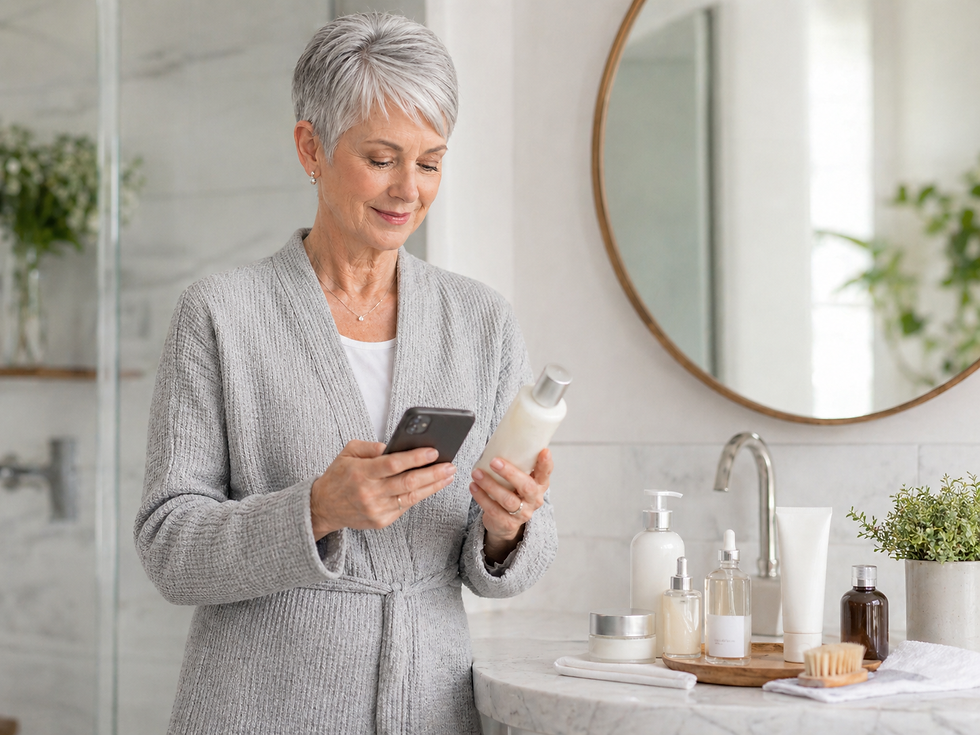
Daily Personal Products
Shampoo, conditioner, body wash, lotion, shaving cream, facial skincare, makeup, and leave-in hair products
A lot of these products can contain things like parabens, phthalates, synthetic fragrance, preservatives, and sometimes even PFAS/forever chemicals. Some also stay in close contact with the scalp, lips, eyes, and face for hours at a time.
➡️ Easy swap: Use Yuka or another product-rating tool to screen your most-used items and avoid products with synthetic fragrance, parabens, phthalates, and fluoro in the ingredient names.
Facial cleansers, serums, and moisturizers
If skincare feels like one of your bigger buckets, I go deeper into that in my earlier post: Lotions, Potions, and Skincare Dramas.
Hair Color + Nail Salons
Are you a mani-pedi nail salon gal? Or maybe you have been dying your hair for decades? Guilty on both counts. 🙋🏻♀️
Think:
hair dye, chemical relaxers, and straighteners
nail polish, gel manicures, and dip powder
salon fumes
While not necessarily daily exposures, they can still be meaningful because they often involve stronger chemicals, repeated contact, and inhalation in close quarters.
Hair dye, chemical relaxers, and straighteners
Permanent hair dyes can contain ingredients like PPD, ammonia, and resorcinol — things associated with allergic reactions, irritation, hormone disruption concerns, and other health questions that are still being studied.
➡️ Easy swap: Ask more questions at the salon, think about ventilation, and consider lower-toxicity options when available.
Gel manicures
Gel manicures add UV exposure, and some products may contain ingredients like TPO that are worth asking salons to avoid.
➡️ Easy swap: To reduce UV exposure, use sunscreen on your hands or gloves with the fingertips cut out.
Dip powder
Dip powders are more of an inhalation issue, and salon hygiene matters if the same powder pots are being shared.
➡️ Easy swap: Ask how the powder is applied and pay attention to ventilation and cleanliness. The same UV-protection tips apply here too.
Laundry, Dry Cleaning + Fabrics
Laundry detergents, dryer sheets, and heavily fragranced fabric softeners
These can leave residue on fabrics that sit against our skin all day long.
➡️ Easy swap: Try non-toxic detergent sheets — I love these because they work and are so convenient compared to those plastic pods full of chemical-laden detergent. Swap dryer sheets for wool dryer balls — I add a few drops of lavender essential oil directly to mine with each load.
Dry-cleaning residue
Dry cleaning can leave behind chemical residue, especially if clothes stay wrapped in plastic.
➡️ Easy swap: Avoid dry cleaning when possible. If you do use it, at least remove the plastic right away and let the garment air out before bringing it into regular rotation.
Synthetic fabrics like polyester
Polyester is essentially a plastic-based fiber, often treated with additional chemicals depending on how it is made or finished. Then add body heat, and there is that plastic + heat issue again.
➡️ Easy swap: Always wash new clothes before wearing them, and choose natural fibers more often when it makes sense.
Stain-resistant or water-resistant clothing treatments
These treatments can add another layer of chemical exposure through fabrics touching the skin all day.
➡️ Easy swap: Be a little more selective with treated fabrics, especially for things you wear often or sleep in.
This does not mean you have to throw out your wardrobe and move to a linen commune.
Receipts. Wait, what?
Many thermal paper receipts are coated with chemicals like BPA or BPS, which can transfer to your skin when you handle them. It’s one of those tiny exposures most of us would never think about — until we do.
➡️ Easy swap: Skip the printed receipt when you can, or avoid crumpling and holding it for long.
⭐ NEXT-LEVEL Swaps for Skin
switch out bedding — sheets, blankets, comforters, and duvets — to natural fibers like cotton, bamboo, eucalyptus, or linen instead of polyester or microfiber
edit your personal-care routine so that you are using fewer and cleaner products, especially NO products with forever chemicals (fluoro in the name)
bring your own gel polish to the nail salon if you have found a TPO-free option
bring your own powder pot to the nail salon if you want more control over dip exposure and hygiene
embrace lower-maintenance hair options — for me, I'm going gray!
The Bigger Why
Yes, this is a lot. And honestly, I am still working on it myself — gradually, over the past four years. One focus at a time. But I am really proud of all the changes I have made.
And let’s not forget our why.
To reduce the toxic burden on our bodies. We are trying to minimize some of the daily exposures that can accumulate and make us feel worse instead of better. We want more joy, energy, clarity, and vitality in this 4th quarter — and this is a practical way to support that goal.
An everyday exposure edit — one healthier choice at a time.
In Part 3, I’m going to talk about how to support the detox systems your body already has — without detox theater.
Stay curious, friends.
Sources & Further Reading
UCSF Program on Reproductive Health and the Environment — Toxic Matters
Practical background on everyday exposures in air, food, water, homes, and products.
EWG — Shopper’s Guide to Pesticides in Produce
Helpful source for your Dirty Dozen / produce pesticide discussion.
FDA — Advice About Eating Fish
Good reference for lower- vs. higher-mercury seafood choices.
EPA — Volatile Organic Compounds’ Impact on Indoor Air Quality
Cleveland Clinic — Gel Nail Polish and UV Exposure
Useful background for the gel manicure / UV section.
Cleveland Clinic — Dip Powder Nails: Pros & Cons
Helpful source for dip-powder hygiene and inhalation concerns.
Really good info! Thank you!